
Hackensack City Directory Holdings
Hackensack has a useful, but uneven, historical shelf. Johnson Public Library lists city directories for 1879; 1898 through 1902; 1906 through 1926; and 1947 through 1956. Those runs are not a continuous annual roll. The Library of Congress also identifies Hackensack street-address directories for several later years, while the Bergen County Historical Society Library preserves telephone-book runs that can bridge some gaps. Each collection answers a slightly different question, so note the title, volume year, and section before treating a listing as evidence.
| Collection | Years | Where Held | Access |
|---|---|---|---|
| Hackensack city directories | 1879; 1898-1902; 1906-1926; 1947-1956 | Johnson Public Library local history | In-library research; ask about the exact volume and nearby-town coverage. |
| Street-address directories | 1934, 1946, 1954-1958, 1961 | Library of Congress guide and collections; local confirmation at JPL | Address-to-occupant lead; verify the local volume or scan access. |
| BCHS telephone directories | 1930-31; 1948; 1954; 1959; 1960-62; 1971; 1973-77; 1981; 1984; 1986-88; 1996-98; 2007; 2016; 2018-19 | BCHS/GSBC Library | Ask the library about municipal scope, appointment access, and the specific book. |
| Bergen Record and local titles | Bergen Record, 1901-present; older titles in uneven runs | JPL, GSBC, and Ridgewood Public Library resources | On-site microfilm, indexes, and library lookup channels. |
A listing is historical evidence, not a current address claim. Incomplete runs, changed publishers, and different town coverage explain many apparent gaps. The research did not establish the final printed Hackensack directory year, so 1956 should be read as the end of JPL's listed run, not the end of every later publication.
Hackensack City Directory Work at JPL
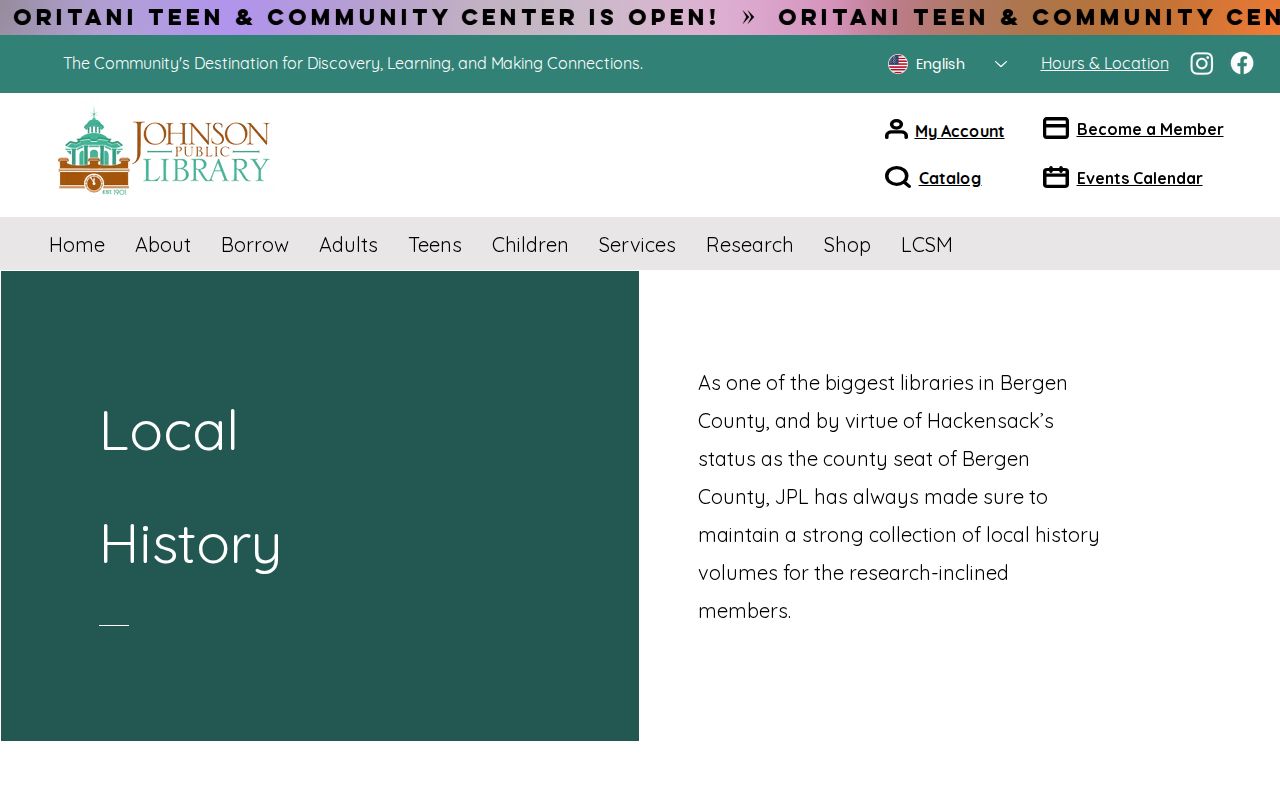
The Johnson Public Library local-history collection is the first local stop for a city directory search. Its local-history room sits in the original 1901 portion of the library at 274 Main Street. The published collection scope includes directories, maps, newspapers, Walker Atlas material, historic-site surveys, master plans, industrial directories, parish histories, and a Record index. Ask the reference desk whether a requested year is on site, in a special collection, or accessible through a licensed resource. A precise request works best: give the surname, approximate year, street, and any spelling variant.
Johnson Public Library's local-history page introduces the setting where those collections are consulted.
A librarian can help locate a reverse directory, a street-number bridge, an obituary date, a map sheet, or a specific directory publisher. Those service paths matter when a name search fails because a volume uses initials, a married name, or a variant spelling.
Note: Some locally held directories were produced for railroad corridors and can include towns north of Hackensack, so read the title page before deciding a listing is city-only.
Bergen County Directory Backups
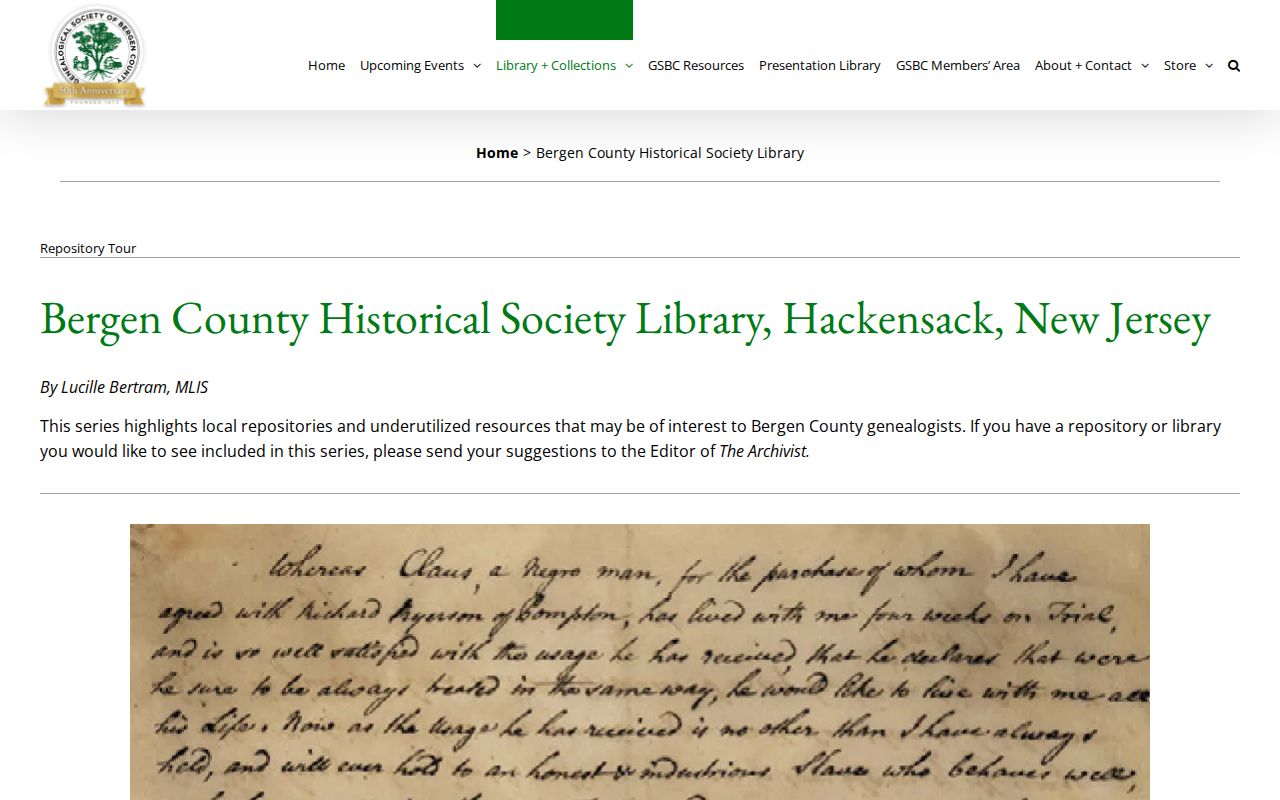
The BCHS Library, supported by the Genealogical Society of Bergen County, supplies a second shelf when a Hackensack city directory is missing. Its Bergen Community College Room 124 collection includes county and town histories, family manuscripts, church and cemetery material, deeds, tax lists, receipts, mortgages, road petitions, photographs, and maps. The stated library hours are Wednesday noon to 5 and Thursday 10 to 3, with appointments arranged by email. Its telephone books have varied geographic scope, so a book's title and date should be recorded with any result.
The BCHS Library collection adds county records that can test a directory lead.
White pages can offer a household-number clue, while classified books are better for a business name or location. Neither should be treated as a public current phone book. For older events, the organization's newspaper resources point to the Hackensack Republican, successor titles, Bergen Record materials, microfilm, and available lookup rules.
Reading a Hackensack City Directory Line
No scanned Hackensack directory entry and abbreviation key were located during the research. The inventory below is therefore a reading checklist based on the Library of Congress description of city directories, not a reconstructed local entry. Capture the title, publisher, year, page, and section when inspecting a real volume. An abbreviation has meaning only if its own volume explains it.
| Name | Surname and given name or initial, useful for separating similar people. |
|---|---|
| Residence or street | An address when printed; it may appear in an alphabetical or address section. |
| Occupation or employer | A useful identity clue when the particular volume includes it. |
| Telephone or household notation | Sometimes present, depending on the year and directory type. |
| Spouse, widow, or ownership notation | Possible clues only when the volume's key defines the mark. |
- Criss-cross directory
- An address-ordered section that can lead from a street number to a listed person or business.
- Householder index
- An arrangement that identifies the principal listed household name rather than every person at an address.
- Abbreviation key
- The volume's explanation of shorthand, often near the front; photograph or transcribe it with the entry.
Do not infer occupancy, title, or a full household from a single line. A city directory is strongest when name, street, occupation, and timing agree with another dated record.
Hackensack City Directory Year Map
Directory research is easier when the gaps are visible before a search begins. The dated local runs begin with 1879, resume for 1898 through 1902, then cover 1906 through 1926 and 1947 through 1956 at JPL. The later Library of Congress street-address guide identifies 1934, 1946, 1954 through 1958, and 1961. BCHS telephone books add uneven coverage after 1930. This layered history explains why the best next source can change from one decade to the next.
- 1879: first Hackensack directory listed in JPL's local run.
- 1898-1902: a later local group follows a long documented gap.
- 1906-1926: JPL lists a substantial city-directory run.
- 1930-31 onward: BCHS telephone holdings begin to fill selected later periods.
- 1947-1956 and 1961: JPL and the LOC guide provide later directory and address-section landmarks.
Federal census schedules, released under the 72-year rule, can bridge a missing directory interval. The New Jersey State Archives also holds historical vital, land, tax, naturalization, and court material, which may help distinguish the right household when the directory shelf is silent.
Trace Hackensack City Directories Across Family Years
For family history, work from one confirmed year rather than jumping across decades. Record a person's full name, initials, spouse reference, occupation, and every address spelling. Then follow that same combination forward and backward through the available Hackensack city directories. A disappearance can mean a move, death, military service, a changed publication pattern, a misspelling, or no listing at all. Pairing an address with a census, newspaper, deed, or church source turns a plausible line into a better-supported identification.
- Choose a directory year close to a known life event and record every printed detail.
- Check earlier and later available years for the same name, initials, spouse reference, occupation, and street.
- Use a reverse or criss-cross section, if the volume has one, to compare the address with a listed person or business.
- Pair each directory period with the matching released census and with dated newspaper notices.
- Use an obituary, deed, tax parcel, church record, or business filing to separate people with the same surname.
The historical volumes are useful leads, while a current parcel or deed question belongs with the modern Hackensack street directory records path. Keep the two time frames separate until documents connect them.
Sanborn Sheets Beside City Directories
Maps make a city directory address easier to place. The Library of Congress identifies Hackensack Sanborn runs for 1885, 1890, 1896, 1902, 1908, and 1915. The 1908 set has 26 sheets, while the 1915 set has 31. A sheet can show a building footprint, use, construction context, and nearby streets. It cannot name every person who used a building, but it can test whether a directory's address was a home, shop, institutional building, or another kind of site.
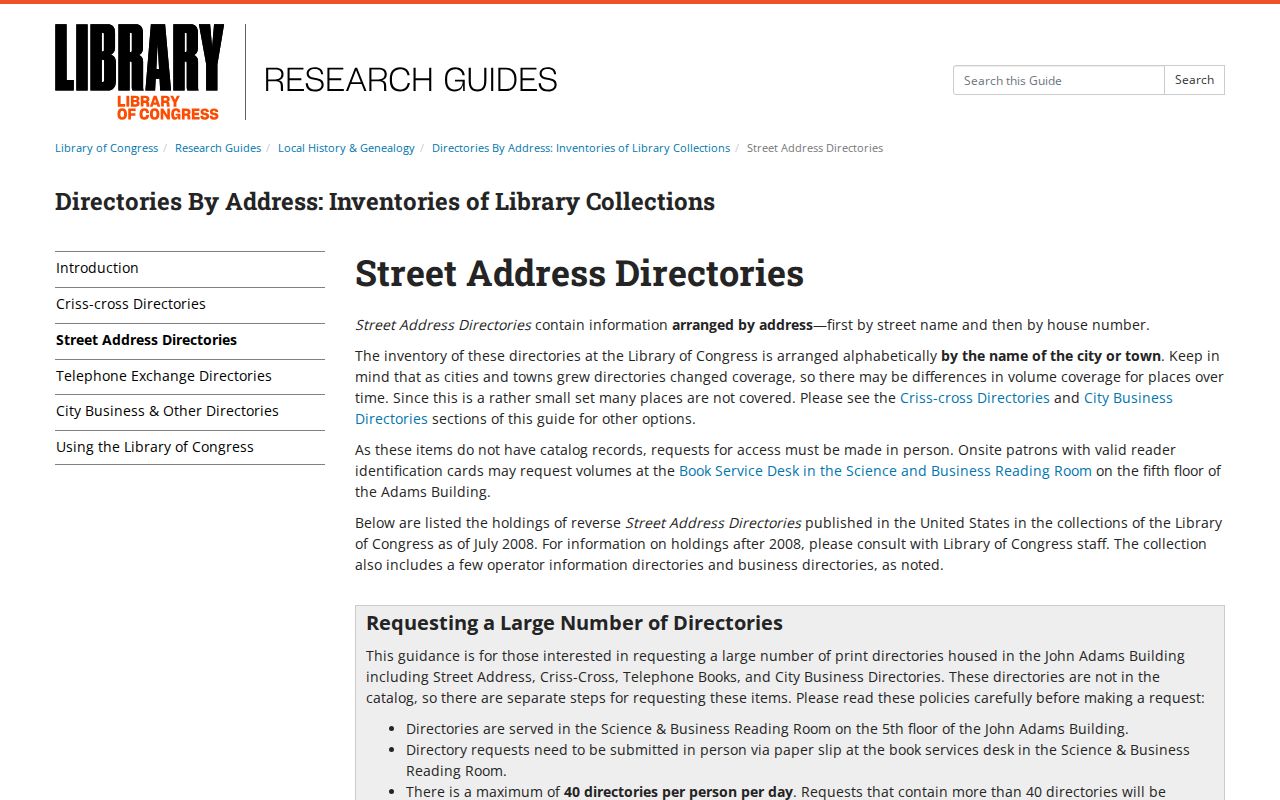
The Library of Congress street-address directory guide records the Hackensack years used for this address layer.
When an old number no longer matches a modern street, search by intersection, adjacent business, church, railroad, or river landmark. Save the map year and sheet number with the directory citation so another researcher can repeat the match.
Hackensack City Directory Names and Rail Lines
Historic naming is a real search issue. The official history places New Barbadoes Township in 1693, joins the Village of Hackensack and New Barbadoes Township in 1896, and records the 1921 referendum that adopted the City of Hackensack name. Older deeds, tax books, church records, newspapers, and directories may therefore use New Barbadoes, Village of Hackensack, Hackensack Township, or City of Hackensack. Search those forms without silently changing what the original record says.
Railroad coverage creates a second trap. JPL warns that some volumes include towns north on the line. A person absent under a Hackensack heading may still be indexed elsewhere in the same volume. Check the town list, then test the result against street, occupation, family details, and another dated source.
Note: A historical directory listing is a lead for family history or local history, and it should never be used to identify or pursue a living person's private location.
Keep Hackensack Directory Records in Context
Use the smallest set of details needed to answer a historical question. A directory may reveal a business, street, occupation, or household clue, but not every record confirms the same fact. The most reliable combination is often a directory line paired with a map, a newspaper date, and a county or state record. JPL, BCHS, the Library of Congress, and the New Jersey State Archives provide different access channels: online guides, local shelves, microfilm, appointment research, and archival collections. A missing online hit is not proof that an original record never existed.
For a recent name or address question, confirm the result with the relevant records custodian. For an older family or property question, preserve citations, spelling variants, and the limits of each source so the trail remains useful to the next researcher.